
If you have searched for fintechzoom.io nasdaq, you are probably looking for a simple way to understand Nasdaq stocks, indexes, market charts, technology companies, and financial trends. However, two separate names are involved here. FintechZoom.io is a financial information website, while Nasdaq operates major securities markets and provides indexes, market data, and financial infrastructure. Understanding that distinction is important because a financial website and a stock exchange serve different purposes. FintechZoom.io currently presents Nasdaq coverage alongside topics such as stocks, the Dow Jones, cryptocurrency, commodities, and financial technology.
This guide explains fintechzoom.io nasdaq in practical terms. It also looks at Nasdaq indexes, stock charts, market analysis, technology stocks, research methods, and data verification. Furthermore, it explains why readers should compare financial information with primary sources before making an investment decision.
What Does FintechZoom.io Nasdaq Actually Mean?
The phrase fintechzoom.io nasdaq generally refers to Nasdaq-related market information available through FintechZoom.io. It does not represent a stock ticker, a separate exchange, or an investment product. Instead, the phrase connects a financial information platform with the Nasdaq market and its widely followed indexes. FintechZoom.io describes itself as a financial technology-focused website that covers Nasdaq, Dow Jones, stocks, cryptocurrency, and other financial subjects. Meanwhile, Nasdaq operates the Nasdaq Stock Market and maintains a broad range of indexes and market services.
Therefore, readers should avoid treating the two names as interchangeable. FintechZoom.io is an information source, whereas Nasdaq is a financial-market operator and index provider. This distinction becomes especially useful when reading price charts or market commentary. For example, an article may discuss the Nasdaq-100 while showing information from a third-party financial website. In that situation, the article provides context, while Nasdaq’s official resources remain an important place to verify index methodology and market information.
Is FintechZoom.io the Official Nasdaq Website?
No. FintechZoom.io is not the official Nasdaq website. Nasdaq’s official website is Nasdaq.com, where users can access market information, stock data, indexes, listings, research, and other services. Nasdaq states that its U.S. equities operations include the Nasdaq Stock Market as well as other exchange venues. It also identifies the Nasdaq Stock Market as a major U.S. equities exchange venue.
Consequently, fintechzoom.io nasdaq should be understood as a search phrase associated with Nasdaq coverage on FintechZoom.io rather than an official Nasdaq service. This matters because readers can otherwise confuse commentary, educational material, and market reporting with primary exchange information. For important figures, checking Nasdaq or regulatory filings adds another layer of verification. The SEC also provides Investor.gov resources designed to help investors research investments and avoid fraud.
How FintechZoom.io Covers Nasdaq Markets
FintechZoom.io presents Nasdaq as one of its major financial coverage areas. Its website says that it follows technology companies, stock trends, earnings reports, and industry developments connected with Nasdaq. It also says that the platform covers other global indexes and individual stocks, including major technology-oriented companies.
As a result, readers searching for fintechzoom.io nasdaq may encounter information covering individual companies, broader index movements, market trends, and technology-sector developments. This approach can be useful when someone wants market information presented in a more readable format. However, financial commentary should still be separated from confirmed market data. A chart or article can explain what happened, but it does not replace company filings, exchange information, or other primary documentation. This distinction helps readers interpret financial content more carefully.
Nasdaq Stocks and Technology Companies
Nasdaq has a strong association with technology and growth-oriented companies. However, it is important not to describe every Nasdaq-listed company as a technology company. The exchange includes businesses from many industries, although technology and innovation-focused firms have a prominent presence.
FintechZoom.io’s Nasdaq coverage can therefore be useful for following themes involving software, artificial intelligence, semiconductors, cloud computing, internet businesses, and other growth industries. Nevertheless, investors should examine each company’s financial statements, business model, competitive position, valuation, and risks. A company being listed on Nasdaq does not automatically make it financially attractive. Instead, the listing provides a market where its securities can be traded under established rules and infrastructure.
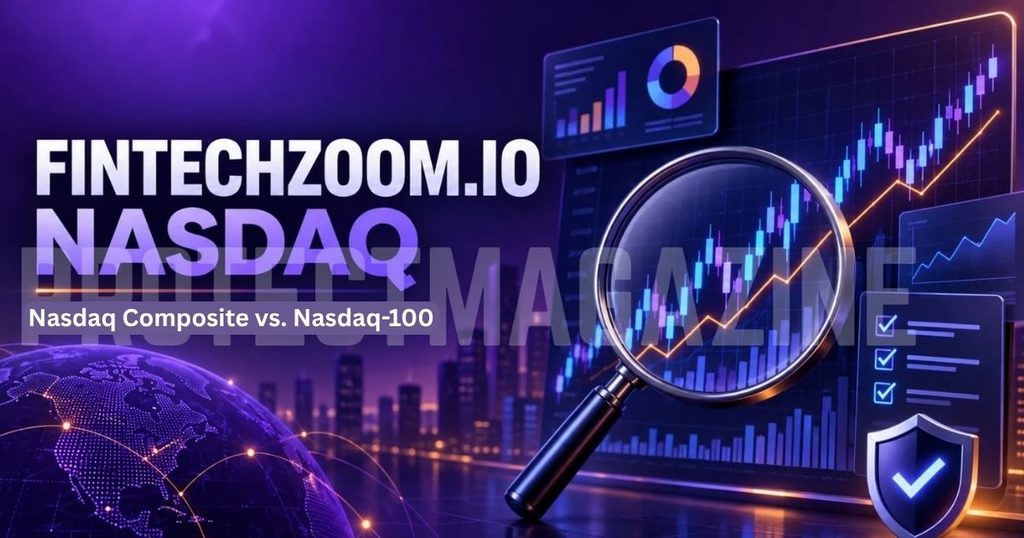
Nasdaq Composite vs. Nasdaq-100
One of the most important concepts for anyone researching fintechzoom.io nasdaq is the difference between the Nasdaq Composite and the Nasdaq-100. Although both indexes carry the Nasdaq name, they are constructed differently and serve different purposes. Nasdaq itself explains that the Nasdaq Composite and Nasdaq-100 have different eligibility rules, construction methods, and weighting approaches.
The Nasdaq Composite is commonly used as a broad measure of securities listed on the Nasdaq Stock Market. By contrast, the Nasdaq-100 tracks 100 of the largest non-financial companies listed on Nasdaq. Because of those differences, their performance can diverge. Therefore, when a website says “Nasdaq is rising,” readers should determine which index the statement actually refers to. Checking the ticker, index name, and methodology can prevent misunderstandings.
Why Index Selection Matters
Index selection matters because different indexes represent different groups of securities. For example, someone researching broad Nasdaq-listed companies may focus on the Nasdaq Composite. Meanwhile, someone studying large non-financial companies may focus on the Nasdaq-100.
Furthermore, many investment products are linked to specific indexes. Nasdaq identifies the Nasdaq-100 and Nasdaq Composite among its flagship U.S. equity indexes and notes that its indexes can serve as the basis for ETFs, futures, options, structured products, and other financial instruments.
Consequently, readers should always identify the exact index before comparing performance. A chart labeled simply “NASDAQ” can be misleading if the underlying index is not clear. Good financial research starts with understanding exactly what the number represents.
Understanding Nasdaq Charts on FintechZoom.io
Charts are among the most useful features for understanding market movement. When reviewing fintechzoom.io nasdaq coverage, a reader may encounter line charts, candlestick charts, percentage changes, historical prices, volume information, or other visual indicators. These tools can make complicated market movements easier to understand.
However, a chart only becomes useful when its timeframe and measurement are clear. A one-day chart tells a different story from a five-year chart. Similarly, percentage performance can provide a different perspective from an absolute index-point change. Therefore, readers should check the date range, interval, asset name, and data source before interpreting a chart. Market prices also change continuously during trading sessions, so a static article may not reflect the latest available price.
Reading Market Trends Carefully
A rising line on a chart does not automatically mean that a security will continue rising. Likewise, a temporary decline does not prove that a long-term trend has ended. Charts describe historical price behavior; they do not guarantee future results.
Technical indicators can also create an impression of precision that exceeds what the underlying data can support. Moving averages, relative strength indicators, support levels, resistance levels, and volume patterns can help organize information. Nevertheless, each indicator has limitations.
Therefore, fintechzoom.io nasdaq readers should treat charts as research tools rather than predictions. Combining price information with earnings, revenue, cash flow, debt, valuation, economic conditions, and company-specific developments can provide a broader picture.
Nasdaq Earnings and Company Research
Earnings reports can have a major effect on individual Nasdaq stocks. Investors often monitor revenue, earnings per share, operating margins, guidance, cash flow, and management commentary. Consequently, financial websites may publish substantial coverage when major Nasdaq companies report quarterly results.
FintechZoom.io’s financial content can help readers understand these developments in accessible language. However, the company’s official earnings release and regulatory filings remain important sources for primary information. A secondary article may summarize results, but the original filing provides the underlying figures and disclosures.
Moreover, investors should compare current results with earlier periods. A company reporting higher revenue may still face declining margins or increasing costs. Similarly, strong earnings growth may have already been reflected in a high valuation. Therefore, a complete research process should consider both financial performance and market expectations.
Why Company Filings Matter
Company filings provide detailed information that short market articles often cannot fully reproduce. Public companies disclose financial statements, risk factors, management discussions, and other information through regulatory channels.
The SEC provides EDGAR and investor resources for researching public companies and investment information.
For that reason, a practical workflow can begin with fintechzoom.io nasdaq coverage to understand a topic, then move to company filings or Nasdaq resources to verify important details. This two-step approach combines readability with primary-source verification. It can also help readers distinguish between facts, interpretation, forecasts, and promotional claims.
FintechZoom.io Nasdaq and Market News
Market news can explain why a stock or index moved during a particular session. Important developments may include earnings announcements, mergers, product launches, economic reports, interest-rate decisions, regulatory developments, geopolitical events, or changes in investor expectations.
However, news headlines can simplify complicated situations. A stock can move after an announcement because investors interpret the information differently from the company’s original message. Similarly, one economic report may affect different industries in different ways.
Therefore, when reading fintechzoom.io nasdaq news, it helps to ask several questions. What happened? When did it happen? Which company or index was affected? Is the information confirmed? Is the article reporting a fact or offering an interpretation? Finally, does the original source support the statement? These questions make market research more disciplined.

How to Use FintechZoom.io Nasdaq for Research
A structured research process can make financial websites more useful. First, identify the exact stock or index you want to research. Next, determine whether you are looking at the Nasdaq Composite, Nasdaq-100, or an individual Nasdaq-listed company.
Then, review the current and historical chart. Afterward, examine relevant company news, earnings information, and broader economic developments. Finally, verify important information using primary sources.
This process reduces the risk of relying on a single article. It also separates market commentary from actual investment research. FintechZoom.io Nasdaq can therefore be viewed as one research layer rather than the only source you consult.
A Simple Nasdaq Research Checklist
Before relying on information about a Nasdaq stock, check:
- The exact company name and ticker.
- The date and time of the market information.
- The relevant index or exchange.
- Recent earnings and company announcements.
- Historical price performance.
- Revenue, earnings, cash flow, and debt.
- Valuation measures where appropriate.
- Major business and industry risks.
- Original company filings.
- Official Nasdaq information when relevant.
Using this checklist can make your research more consistent. More importantly, it helps prevent one chart, headline, or forecast from becoming the entire basis of an investment decision.
FintechZoom.io Nasdaq and Investment Risk
Every investment involves risk, and Nasdaq-listed securities are no exception. Technology-oriented stocks can sometimes experience significant price movements because investors respond quickly to earnings expectations, economic conditions, interest rates, innovation cycles, and competitive developments.
Furthermore, historical performance does not guarantee future results. A company that performed strongly during one period can face new competitors, weaker demand, higher costs, regulatory changes, or other challenges later.
Therefore, readers should not interpret financial commentary as a guarantee. When fintechzoom.io nasdaq content discusses possible future movements, treat those statements as analysis or forecasts rather than established outcomes. The SEC provides investor education and alerts intended to help people evaluate investment opportunities and identify potential fraud.
How to Verify Nasdaq Information
Verification is particularly important when financial information includes live prices, market forecasts, or claims about a particular company. Nasdaq provides official market-data resources, including stock information, indexes, and other market tools.
For company-specific information, regulatory filings can provide another important verification layer. The SEC’s resources include EDGAR and investor-focused tools.
Consequently, readers can use fintechzoom.io nasdaq as an entry point for understanding market topics while checking significant facts against primary sources. This approach is especially useful when an article contains precise prices, earnings figures, ownership information, forecasts, or claims about a company’s financial position.
Watch the Date of Market Information
Market data has a time dimension. A price displayed today can become outdated quickly. Therefore, always check when the information was published or updated.
This is particularly important for articles that continue to appear in search results long after publication. An old market article may still provide useful background, but its price figures and market conditions may no longer apply.
For current Nasdaq information, official market resources can provide more appropriate data. Nasdaq’s website includes market activity, stocks, indexes, and other financial information.
Benefits of Using Financial Information Platforms
Financial information platforms can make complicated subjects easier to understand. Instead of reading technical exchange documentation immediately, readers can begin with an explanatory article and then investigate the original sources.
Additionally, financial websites can bring several topics together. FintechZoom.io describes coverage spanning Nasdaq, Dow Jones, stocks, cryptocurrency, and other financial areas.
This broader context can help readers connect company developments with larger market themes. For example, semiconductor companies may be influenced by AI investment, supply-chain conditions, consumer demand, and interest rates at the same time.
Still, convenience should not replace verification. The strongest research process uses accessible explanations alongside reliable primary information.
Common Mistakes When Researching Nasdaq
One common mistake is assuming that “Nasdaq” always means one specific index. As explained earlier, the Nasdaq Composite and Nasdaq-100 are different indexes.
Another mistake is treating a financial information website as the exchange itself. FintechZoom.io and Nasdaq are separate entities. Readers should also avoid assuming that past stock performance guarantees future returns.
Furthermore, relying on one technical indicator can produce an incomplete picture. Financial markets respond to many variables, including company results, valuation, interest rates, economic growth, investor expectations, and unexpected events.
Finally, readers should be cautious with claims that promise certainty. Markets involve uncertainty, and responsible financial research should acknowledge that uncertainty rather than hide it.
Is FintechZoom.io Nasdaq Useful for Beginners?
For beginners, fintechzoom.io nasdaq can be useful as a starting point for learning about Nasdaq-related financial topics. Its content is presented in a way that can help readers explore market concepts, companies, and financial trends.
However, beginners should build their knowledge gradually. Start by learning the difference between stocks and indexes. Then understand market capitalization, earnings, revenue, valuation, dividends, volatility, and risk.
Afterward, learn how to read basic financial statements and company filings. Finally, compare information across multiple sources. This process is more reliable than trying to make decisions from a single article.
The most valuable goal is not simply finding a stock symbol or market prediction. Instead, it is learning how to evaluate financial information independently.
FintechZoom.io Nasdaq: Key Takeaways
The main point is straightforward: fintechzoom.io nasdaq refers to Nasdaq-related coverage associated with FintechZoom.io; it is not the name of a stock or a separate Nasdaq exchange.
Nasdaq itself operates major securities markets and provides important indexes, data, and financial services. FintechZoom.io, meanwhile, presents financial information and analysis covering Nasdaq and other market subjects.
When using the platform, identify the exact index or stock being discussed. Check the date of the information. Review charts carefully. Separate facts from forecasts. Most importantly, verify important financial information through official Nasdaq resources, company filings, and SEC resources.
That approach allows you to use financial websites for education without confusing commentary with primary market information.
Frequently Asked Questions About FintechZoom.io Nasdaq
What is FintechZoom.io Nasdaq?
FintechZoom.io Nasdaq generally refers to Nasdaq-related market information, analysis, charts, and financial content available through FintechZoom.io. It is not a separate stock or exchange.
Is FintechZoom.io the official Nasdaq website?
No. FintechZoom.io and Nasdaq are separate. Nasdaq’s official website is Nasdaq.com, which provides exchange, market-data, index, listing, and financial-market resources.
Is FintechZoom.io Nasdaq a stock?
No. The phrase is not a stock ticker. It generally describes Nasdaq-related information associated with FintechZoom.io.
What is the Nasdaq Composite?
The Nasdaq Composite is a broad index associated with securities listed on the Nasdaq Stock Market. It differs from the Nasdaq-100, which tracks 100 of the largest non-financial companies listed on Nasdaq.
What is the Nasdaq-100?
The Nasdaq-100 is a major Nasdaq index covering 100 large non-financial companies listed on the Nasdaq Stock Market. Its methodology differs from that of the Nasdaq Composite.
Can FintechZoom.io be used for stock research?
Yes, it can be used as one source for financial information and market analysis. However, important figures should be checked against primary sources such as company filings, Nasdaq resources, and SEC information.
Does Nasdaq information stay the same throughout the day?
No. Market prices and trading information can change during market hours. Therefore, readers should check the date and time associated with market data before relying on it.
Conclusion: Use FintechZoom.io Nasdaq as Part of a Bigger Research Process
FintechZoom.io Nasdaq is best understood as a phrase connecting FintechZoom.io’s financial coverage with the Nasdaq market. FintechZoom.io provides financial information and analysis, while Nasdaq operates major securities markets and maintains important market indexes. Understanding this difference is the first step toward using the information correctly.
Furthermore, readers should distinguish between the Nasdaq Composite and Nasdaq-100, understand what market charts actually measure, and check the date of financial information. More importantly, major claims should be verified through primary sources. Nasdaq provides official market resources, while the SEC provides investor education and regulatory information.
Ready to explore Nasdaq more carefully? Start with the stock or index you want to understand, review its official market information, compare credible sources, and then build your research from verified facts. A thoughtful research process can help you understand market movements without relying on a single headline, chart, or prediction.








One Comment